Epsom & Ewell Borough Council has one of the ten oldest, and most out-of-date local plans in the country, dating back to July 2007. Renewing the local plan has suffered years of delays and setbacks, putting the borough firmly in the sites of central government.
If Angela Rayner’s proposals for planning policy changes are rolled out in December as expected, the Borough’s housing targets will more than quadruple from the 181 dwellings per annum required to be delivered under the current ‘Core Strategy 2007’, to 817 dwellings per annum. This would result in Epsom & Ewell growing by 50% over the plan period, fundamentally changing its character and resulting in ever increasing traffic jams and a lack of infrastructure and facilities such as schools and GPs.
Epsom only has enough available brownfield land for approximately 4.5 years of building at Rayner’s proposed target rate. Once this brownfield land is used up, Green Belt land will need to be sacrificed at a rate of over 20ha per year to meet this target. That’s equivalent to an area of over 50 football pitches every single year.
Councillors have recognised that the proposed housing target is much too high, writing to Angela Rayner on 13 September 2024 stating ‘these new numbers are immense and could destroy our historic district and market town.’
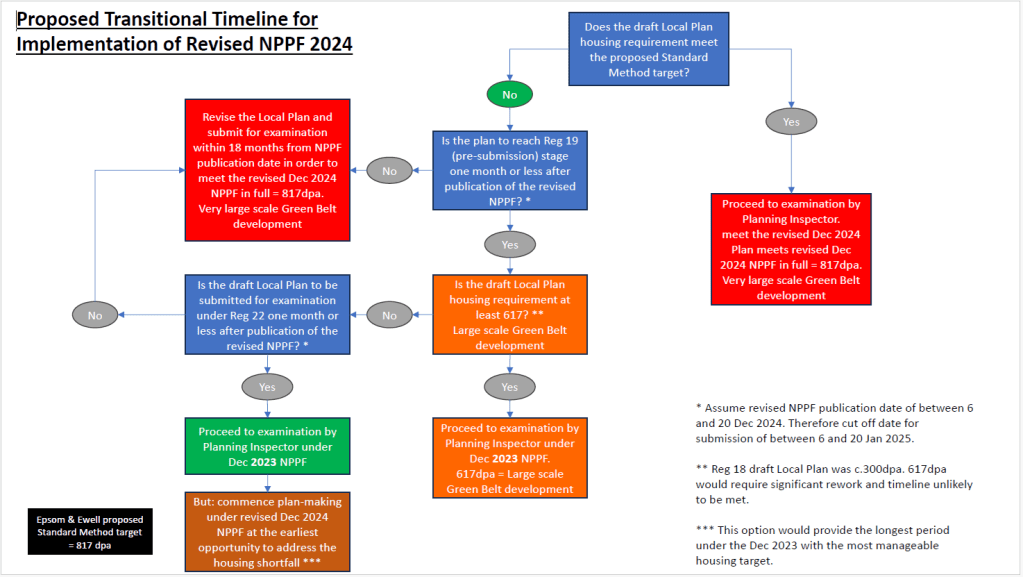
In the latest edition of the Ewell Village Residents Association, councillors have also acknowledged that, if they don’t submit a revised Local Plan to the planning inspector by early January 2025 using the existing planning rules and targets, they will need to significantly rework the Local Plan proposals over the following 6 months to meet the astronomical new targets. If this happens, none of the Green Belt would be safe.
If the draft Local Plan is not submitted for review to the Planning Inspector by early January, there will be very serious implications for the borough:
A mandatory housing target of 817 dwellings per year will be applied
The council will have to identify hundreds of hectares of Green Belt land, allowing building on all available land across the borough.
The cost of the Local Plan, already £1.37m above the original budget, will increase significantly as considerable further work will be required.
The, already very out-of-date current local plan will be extended for a further period during which speculative development will increase.
There is a solution. Or at least the possibility of a stay of execution.
After years of delays to the Local Plan process, including another 11-month delay approved in November 2023, the council should now claw a month or two back and accelerate the public consultation and submission to the planning inspector.
It is still possible for the council to delay the impact of Ms Rayner’s proposals if the draft Local Plan is issued for the 6-week consultation before the end of October 2024, and then submitted to the planning inspector in early January 2025.
Other councils have taken these steps. For instance, Winchester council stated ‘Given the advanced stage of work that the new Local Plan has reached, and the significant delay and cost if matters are not expedited at this juncture, Officers therefore have recommended that the new Local Plan be approved by Cabinet and the Council for publication and then submitted for examination as soon as practically possible.’ Their plan subsequently went out to consultation in late August, giving them a chance to beat the deadline.
Other councils, such as St Albans and Uttlesford District Council have progressed similar steps. St Albans Council have taken the unusual approach of opening the 6 week consultation on their draft Local Plan, on 26 September 2024, before obtaining full council approval, scheduled for 16 October. This makes sense, as the consultation results do not impact the Local Plan that is to be submitted for inspection, so the two activities can be undertaken concurrently to save precious time in the process.
At the 24 Sept 2024 LPPC committee meeting, Residents Association councillors assured residents that they were doing all they can ‘to preserve and protect the Green Belt’, with Cllr Goldman (RA) asking residents to ‘trust us’.
This being the case, the council should focus all their efforts on issuing the draft Local Plan for consultation by the end of October to save time, save money and save the borough from the destruction foreseen by Cllr Dallen in his letter to Angela Rayner. Residents will trust councillors to do the right thing if they see those councillors getting on and doing it.
20th November 2024, the 10 members of the Licencing Policy Planning Committee (LPPC) will vote whether to approve the Local Plan to submit to Full Council.
10th December 2024, the Full Council of 35 councillors will vote whether to approve the Local Plan.
December 2024, Angela Rayner’s new National Planning Policy Framework (NPPF) due to be set in concrete (Communities unable to block planning).
Please email your Ward councillors, LPPC councillors and senior Council Officers ASAP requesting that they take action now to start Regulation 19, issue the consultation and complete the Local Plan process.
LPPC Councillors:
Peter O’Donovan (Chair) – Ewell Court (RA) – po’donovan@epsom-ewell.gov.uk Neil Dallen (Vice-Chair) – Town (RA) – ndallen@epsom-ewell.gov.uk Robert Leach – Nonsuch (RA) – rleach@epsom-ewell.gov.uk Rob Geleit – Court (Labour) – rgeleit@epsom-ewell.gov.uk Shanice Goldman – Nonsuch (RA) – sGoldman@epsom-ewell.gov.uk Julie Morris – College (Lib Dem) – jmorris@epsom-ewell.gov.uk Phil Neale – Cuddington (RA) – pneale@epsom-ewell.gov.uk Kieran Persand – Horton (Conservative) – kPersand@epsom-ewell.gov.uk Humphrey Reynolds – West Ewell (RA) – hreynolds@epsom-ewell.gov.uk Clive Woodbridge – Ewell Village (RA) – cwoodbridge@epsom-ewell.gov.uk
Regulation 19 is part of the Town and Country Planning (Local Planning) (England) Regulations 2012. It says that, before submitting a draft Local Plan to the Government’s Planning Inspectorate for independent examination, the Council must publish a draft of the Local Plan and formally invite comments (known as representations) on it. This version of the Local Plan is known as the Publication Plan.
The Regulations make clear that the Council must inform and invite representations / comments, not just from consultation bodies like the Environment Agency, Natural England and Historic England, but also from residents and businesses in the area covered by the Local Plan. The Regulation 19 consultation no longer seeks views on alternative options, but instead presents the opportunity to comment on the content of the Local Plan, within a specific remit. The focus/sole purpose for this consultation relates to receiving representations on:
Legal Compliance – does the plan meet the legal requirements made under various statutes? Soundness – has the plan been positively prepared, justified, effective, and consistent with national policy? Meets the Duty to Cooperate – has the Council engaged and worked effectively with neighbouring authorities and statutory bodies?
We are writing to complain about the performance of the Licensing and Planning Policy Committee (‘LPPC’) with respect to the draft Local Plan.
The Council’s FAQs page opens with the statement ‘The Local Plan is a critical document in shaping the future of the borough.’ This is indeed the case as, according to the Regulation 18 Local Plan consultation document, it ‘guide[s] the location, scale, and type of development in the borough up to 2040’. The impacts will be felt well beyond that timeframe, particularly where they involve building in new areas.
Given its importance, residents expect the Local Plan to be the focus of significant attention, strategic direction, control, challenge and scrutiny throughout its preparation. According to its Terms of Reference, these tasks are delegated to the LPPC. They include being:
Responsible for influencing and controlling development and use of land as Local Planning Authority including:
a) Preparation, adoption and review of the statutory Development Plan, including Local Development Documents.
b) Preparation, adoption and review of Supplementary Planning Documents.
For a plan that is so critical to the future of the Borough, it is imperative that the elected members provide strategic input to plan development, and scrutiny, challenge and direction to major policies and decisions, both early in the process and throughout the plan’s development. Not only is this fundamental to successful project management, it is also required under para 33A of the Planning and Compulsory Purchase Act 2004 which mandates that the authority ‘engage constructively, actively and on an ongoing basis in… the preparation of development plan documents and the preparation of other local development documents’.
All critical Local Plan decisions, such as whether or not to argue there are exceptional circumstances for redrawing Green Belt boundaries, should be reviewed and officially approved by the LPPC.
The Regulation 18 Local Plan was issued for consultation between Feb and March 2023. The period leading up to that consultation should have involved significant input from the LPPC in order to fulfil its mandate. It has been thirteen months since the consultation concluded and there are only 7 months remaining until the Regulation 19 Local Plan is due to be submitted to the LPPC for final approval before sign-off by full council. As the Interim Director of Environment, Housing and Regeneration stated in the LPPC meeting on 22 Nov 2023, ‘no substantial changes can be made to the Regulation 19 Local Plan once it has been agreed to go out to consultation’. The last 13 months must therefore have required extensive challenge, debate and decision making by the LPPC to comply with its Terms of Reference and ensure that the highest quality plan is developed for the Regulation 19 consultation. Not a plan that simply meets officers’ ambitions, but one that reflects the relevant views of residents, those views being championed by their elected councillors.
Given this context, the following analysis is deeply concerning:
Of the 21 scheduled LPPC meetings since Jan 2022, only 13 have been held.
None of these involved debate of the overall Local Plan strategy or content.
None have involved the debate or challenge of the Spatial Strategy.
None have involved the debate or challenge of the Plan policies.
None have involved the debate or challenge of critical decisions.
None have addressed the results of the analysis of the 1,736 responses to the public consultation completed on 19 March 2023, despite the ongoing analysis being permitted to continue during the Local Plan pause. No discussion has been held around the expected impact on the Reg 19 Local Plan despite a statement to the Jan 2023 LPPC that this would be produced. This appears critical given the large level of disagreement from the public.
None of the LPPC meetings held in 2021 addressed these matters either.
In order to direct the Local Plan, the LPPC cannot wait until ‘We… publish a Consultation Statement alongside the next version of the Local Plan that will provide a summary of the main issues that have been raised and our response.’ as stated on the consultation website, as this will be too late to provide input to decisions taken.
In addition:
When members of the LPPC requested information (as set out in the minutes of the meetings) there is no evidence it was provided.
When members asked to discuss Local Plan related matters at later meetings, the matters were not included in the agendas of later meetings.
The published Local Plan timetable does not provide for any debate, challenge, steer or decision with respect to options to be taken on the Local Plan prior to a recommendation to the LPPC, expected in November 2024.
The EEBC risk register lists several major risks relating to the Local Plan timetable and failure to obtain approval from councillors for the Regulation 19 Draft Local Plan. Ensuring that key decisions are discussed, debated and agreed well in advance of the approval deadline, to enable appropriate analysis and drafting to take place, resulting from these decisions, is one of the most significant factors to addressing timetable risks.
Despite the lack of scrutiny, challenge or direction from the LPPC noted above, the Local Plan budget has increased by £1.37m since March 2021 and a 17 month timetable slip has occurred since April 2022 (a 42 month timetable slip since August 2020). These significant levels of overrun appear not to have resulted from scrutiny, policy changes, etc but from further project management failures. The minutes of the meetings approving the slippages do not indicate that officers were held to account, or that more frequent or detailed timetable and budget scrutiny has been introduced. To the contrary, three of the last 5 LPPC meetings have been cancelled, one didn’t include discussion of the Local Plan at all, and one simply approved a further timetable extension.
There is no single right answer to the Local Plan. In the 26 Sept 2023 LPPC meeting, the Planning Policy Manager stated that ‘the inclusion of some green belt release alongside urban sites is the appropriate strategy to take and one that potentially poses the least risk at examination stage.’ It is not the Planning Policy Manager’s role to make this decision and it is concerning that this was left unchallenged. Whilst there are risks as to what a Planning Inspector might approve, different Planning Inspectors will take different approaches. The ‘least risk’ is frequently not the best option to take. The LPPC should be presented with options in order to determine the preferred balance between risk and benefit.
Please can you urgently confirm:
The detailed timetable for the scrutiny, challenge and direction of each significant element of the Local Plan by the LPPC
The date on which the analysis of the consultation results, and proposed amendments arising from it, will be presented to the LPPC for adjustment and/or approval
That the LPPC will be given the freedom, opportunity, time and resources sufficient for it to fulfil its mandate, as set out it its Terms of Reference, without undue constraints or interference from officers
That review, challenge and direction of the Local Plan will be included in the agenda of every meeting of the LPPC to be held until publication of the Regulation 19 consultation
That there is sufficient time and budget to accommodate any and all changes the LPPC may recommend
That a contingency plan is in place should the currently proposed Local Plan timetable slip for any reason, including matters arising from the review and challenge set out above.’
On 20 Feb 2024, Epsom and Ewell Borough Council published a new FRP section on its website (‘Frequently Repeated Propaganda’), mistitled ‘FAQs’.
In an article to the Epsom and Ewell Times, Cllr McCormick introduced the new FRPs (FAQs) stating:
“We want to make sure that all those who live in, work in and visit the borough have access to the latest information about the Local Plan, to ensure that they are informed and to dispel rumours and myths about the Plan.”
Let’s dispel some rumours and myths with some real Frequently Asked Questions.
Is the Local Plan important?
Yes. It is the single most important decision-making document the council will issue for the next 15 years. It sets out everything from where commercial, industrial and residential buildings can be constructed, to how the environment will be protected, from what roads and schools are needed, to the policies against which all development will be assessed. It maps out the future of the borough and therefore will have a fundamental impact on the lives of all residents. It is critical that the right decisions are made now as, once the plan is issued it can’t be undone.
Where can I find more information on the changes to the Local Plan?Sorry, ayear after the consultation on the draft Local Plan, and despite analysis offeedback continuing during the ‘pause’ in 2023, there remains no information onwhat changes are being considered (or have been made) as a result of theconsultation.
The latest information was published in January 2023. Either the council has been doing nothing for a year, or there is something they’re not sharing. There are currently no plans to share information with the public until 2025.
Why have consultation responses not been analysed and responses published?
On 22 March 2023, the council voted to ‘pause’ the Local Plan. This pause was ‘other than for the purpose of analysing the responses of the public consultation to capture residents’ views and any new information.’ That work therefore continued.
The Local Plan process was ‘unpaused’ on 24 October 2023. After almost a year nothing has been published. For 7 months of this time, council officers working on the local plan could focus only on analysing responses due to the ‘pause’. Still nothing.
It is the absence of official and reliable communication residents are left with only conjecture and rumours. In the absence of information, it can be assumed that officers have found that public opinion doesn’t align with their plans, so they are keeping it under wraps. Time will tell.
Are there Local Plan decisions still pending?
Presumably. The Licensing and Planning Policy Committee (‘LPPC’) is responsible for ‘influencing and controlling development and use of land … including preparation, adoption and review of the statutory Development Plan’ on behalf of the Council.
Lots of decisions should have been taken by now on the direction the Local Plan should take. So far, the LPPC appears not to have taken any decisions on the content of the Local Plan. According to the council’s FAQs, the LPPC is not going to receive recommendations until November 2024.
How can the LPPC fulfil its responsibility for preparation of the Local Plan if the first they see of it is the proposed answer? They are only scheduled to see the recommendations just before the plan needs to be published, so with no time to change it. That sounds like rubber stamping decisions already made.
If the Council committee responsible for the Local Plan (the LPPC) doesn’t know what’s happening, how is the plan progressing?
Attempts to give direction to officers not to build on Green Belt, proposed by Cllr Howells (RA) at a full council meeting held in October 2023, were voted down by her fellow Residents Association councillors and Labour.
Unelected officers are continuing to make decisions with no accountability.
What is a Spatial Strategy and has it been decided yet?
The Spatial Strategy sets out what each area of the Borough can be used for, whether than be commercial, industrial, residential or the environment. The draft Spatial Strategy included development of almost 57 hectares of Green Belt land (140 football pitches). Of this, 5 hectares is at West Park Hospital and is classified as ‘previously developed land’ (as it already has buildings on), which should be prioritised for development in line with Government guidance.
Over 50 hectares allocated for development in the draft local plan is protected, ‘high-performing’ (i.e. good quality) Green Belt land. The council FRPs (FAQs) state that the Spatial Strategy remains uncertain. Interpreting what they have stated, they tried to get councillors to agree on what land should be developed in private briefings. They didn’t want residents to know the briefings were happening or what was being discussed – this secrecy was confirmed by the council’s legal officer in a public meeting of the Strategy and Resources Committee on 25 Jan 2024.
Why did they not want residents to know? Because officers were pushing for development of Green Belt land which 87% of residents had rejected in the Feb 2023 consultation and they didn’t want to deal with the push back? Despite the fact that ‘the council has been unable to solidify the strategy’, the proposals were sent to Surrey County Council in January 2024 to develop infrastructure plans.
No consensus, no decisions, ignoring residents’ concerns and ploughing on regardless.
What is the timeline for Local Plan Decisions?
The council has only published the vaguest and highest-level timetable. It states we are in ‘Stage 3’, which lasts for two years from March 2023 to Feb 2025. A normal project plan would include multiple ‘milestones’ (short term actions and decisions) to ensure the project runs to timetable and meets objectives. This hasn’t been published, so the public are left in the dark.
The valid concern, in the absence of any information, is that decisions are being made that don’t align with the clear evidence for saving the Green Belt. Or perhaps worse, that no decisions are being made at all, councillors are not controlling the process, and an unacceptable mess will be presented to the LPPC in November for their recommendation.
The timetable is?… there is no timetable.
What happens if the LPPC or Full Council don’t agree with the officers’ recommendations in November 2024 – January 2025?
There is no published plan for what would happen should the un-steered, officer-drafted plans fail to meet with the approval of councillors.
Based on the videos of previous meetings, councillors will be pushed into approving what is presented. This is likely to be on the basis that rejecting the proposals would result in missing the timetable for getting the local plan accepted, and waste £millions. In short, the plans are likely to be approved under duress.
Open, transparent and timely decision-making on the direction and content of the Local Plan, is likely to be required by March/April 2024, to avoid this unacceptable outcome. The decisions, whether explicit or implicit, are being made now.
How will the next consultation work in Feb/March 2025?
Despite the thousands of detailed responses to the last ‘Regulation 18’ consultation on the Local plan, held in Q1 2023, a year later no information has been published on how this is expected to impact the direction or content of the plan. The FRPs (FAQs) state that this analysis will be published in 2025, together with the next consultation.
The results of the next ‘consultation’ (in 2025) do not get assessed by the council to feed into the Local Plan. The responses are sent to the Planning Inspector, the person responsible for reviewing the draft plan to see if it is acceptable. The focus of that review is likely to be on whether there are technical errors in the plan, not on the nature or scale of public opinion.
If nothing useful resulted from the 2023 consultation, the 2025 consultation is unlikely to be better. Councillors need to take control of the Local Plan process now and make the strategic and policy decisions they were elected for.
What does the ‘Data informing the Local Plan preparation’ (evidence) show and is it being followed?
The Council has procured a wide array of information to inform the Local Plan preparation. This was published in Jan 2023 to support the consultation. Further information and analysis has been prepared since but not published. At a very high level, the existing evidence showed:
Housing: That the council has not calculated housing requirements as required by the National Planning Policy Framework (‘NPPF’) para 61. Instead they have relied only on the ‘advisory starting point’ of the universally-criticised and vastly inflated ‘Standard Method’ figure. This figure hasn’t actually been used to determine how many houses to build, but has been blamed for building on Green Belt.
Green Belt: The Green Belt report states that the overwhelming majority of the Borough’s protected Green Belt is ‘high performing’, i.e. excellent quality and doing exactly what it was intended to do. Despite it being protected, excellent quality and highly valued by residents, officers are choosing to build on it when they are explicitly permitted by NPPF para 145 not to do so. They are then arguing that there are exceptional circumstances to build on it. They are choosing to make this argument, even though it is tenuous at best.
Transport assessment: This assessment highlights that the Green Belt sites selected for development are generally not advised for housing due to the poor links to important services, transport and infrastructure.
Flood risk assessment: This highlights that a significant proportion of the Green Belt sites selected for development are subject to critical drainage (flooding) risks. The Local Plan stated that development would be ‘Located away from areas of flood risk’, but has then specifically chosen flood risk sites for development.
The council appears to be ignoring the evidence base and choosing to build on the Green Belt. They have not explained why.
What is the current housing need in the borough today?
Rather concerningly, the council’s FRPs (FAQs) have misrepresented their own data.
Firstly it quotes a target of 575 homes / year. There is no such target either locally or set by central government.
The figure quoted is the output of the specifically inflated, unconstrained ‘advisory starting point’ for ‘informing’ housing requirements, the ‘Standard Method’. This includes the use of 2014 data, that has been proven to have significantly inflated population growth, and adds a 40% uplift. It isrequired to use this information as an input to determining housing requirements. It is then necessary to identify and analyse other pertinent inputs to derive an appropriate housing requirement for the area. This has not been done.
Using 2018 government ‘ONS’ data indicates households growing from 31,694 households in 2022 to 34,117 households in 2040, an increase of 2,423 households, or 135 homes/year.
The existing, brought forward housing need from the homeless register of 850 (HEDNA para 13.12) equates to an additional 47 homes/year. This totals 3,273 homes or 182 homes / year.
Compare this to the available brownfield (and previously developed) sites, identified by the council, for 3,864 homes, nearly 600 homes more than needed. There is no need to build on Green Belt land to meet this need.
Secondly, it bizarrely misquotes the ‘Housing and Economic Development Needs Assessment (‘HEDNA’), as requiring 652 affordable housing units per year. The HEDNA indicates that this figure ‘includes a proportion of households that are already in housing (i.e. they do not generate a net additional need for housing).’ The HEDNA states that ‘the current annualised estimate of households in affordable need, based on the Housing Needs Register, is therefore 47 households per year.’
According to the council’s data, the borough delivered 67 affordable homes in 2022/23.
Embarrassingly, the FRPs go on to state that the council is currently spending £2m of taxpayers’ money, each year, on emergency accommodation. At the same time it is not forcing developers to meet their obligations to build affordable housing (under planning approvals) and is not using developers’ financial contributions to procure the affordable housing they pay towards. Instead the Council is holding onto these funds and redirecting the interest to pay for other services rather than resolving the housing needs.
The solution is not to build inflated numbers of large houses on Green Belt land, it is to :-
build the right number of social and affordable apartments on the available brownfield sites,
hold developers accountable for delivering the affordable housing included in planning approvals
use the funds provided to procure (or develop) affordable housing rather than appropriating the income for other uses
Can our housing and economic needs be met on just brownfield sites?
Yes! As shown above, the borough’s housing requirements can be fully met by building on the already-identified brownfield sites.
Can Longmead and Kiln Lane industrial estates be developed for housing?
These estates include significant areas of under-utilised land. The fact that the council has stated that there is no scope to optimise these estates to deliver any housing shows an embarrassing lack of understanding of land development options.
It is possible to retain, enhance, and even expand the level of commercial, light-industrial and other uses of the site, whilst delivering significant levels of additional homes. Existing leases are not a barrier to development. Frequently lease-holders are keen to renegotiate and to move to newer, better-serviced premises. Similar estates in other boroughs have been developed creatively to significantly enhance their use, attractiveness and value.
The council has refused to engage with developers, however the Green Belt Group has spoken to developers who are very interested in designing and developing a thriving mixed-use site. The council owns a significant proportion of the site but has not submitted it for consideration. As a result it is hampering its own delivery ambitions.
Must Green Belt Land be developed?
No. The recent updates to the National Planning Policy Framework (NPPF) state that
‘once established, there is no requirement for Green Belt boundaries to be reviewed or changed when plans are being prepared or updated.’
The council has a choice. It should choose to protect the Green Belt.
The council correctly states:
‘The NPPF makes clear that it is at the discretion of Local Authorities as to whether Green Belt boundary is amended through the Local Plan process. Any changes need to demonstrate exceptional circumstances, and before concluding that exceptional circumstances exist, local authorities will need to demonstrate that the Local Plan:
makes as much use as possible of suitable brownfield sites and underutilised land
optimises the density of development in the urban area
has been informed by discussions with neighbouring authorities about whether they could accommodate some of the identified need for development – these conversations with neighbouring authorities will continue to take place as the plan develops.
This flexibility remains within the NPPF to reflect that Green Belt authorities all have their own unique characteristics, challenges and requirements, and that Local Plans must still address competing and conflicting demands for land.’
The council hasn’t complied with any of these requirements. Nevertheless, despite stating that it has the ‘discretion’ and ‘flexibility’ as to whether to approve building on the Green Belt, and despite the overwhelming level of public support to protect it, the council continues to forge ahead with undesirable, unethical and unnecessary plans to build on greenfield Green Belt sites.
The FRPs (FAQs) from the council state that the Clarendon Park, Livingstone Park and Manor Park estates were developed on Green Belt Land because they were shown to meet very special circumstances. In reality, the estates were built on ‘previously developed land’, not the undeveloped Green Belt land currently being proposed.
It remains fully acceptable to develop previously developed land such as West Park Hospital. It is not appropriate to build on Horton Farm, Priest Hill, etc.
What happened at Langley Vale?
A development proposed in Langley Vale, in the Green Belt, was rejected by EEBC. This decision was overturned by the planning inspector because Epsom & Ewell does not have an up-to-date Local Plan setting out where development is to be permitted.
The responsibility for the lack of a local plan lies entirely with the Residents Association controlled local council. Epsom & Ewell has one of the oldest Local Plans in the country but has failed to produce a new one, leaving the borough’s precious Green Belt at the mercy of speculative development.
The answer? Prepare a local plan that allocates housing on brownfield and previously developed sites and excludes Green Belt. If this had been in place already, Langley Vale would not be developed.
What further official opportunities will there be for local residents to feed back?
There is only one and it will probably be too late by then for residents’ opinions to make a difference.
The next public consultation on the Local Plan (Regulation 19) is expected to be in early 2025. By then the version of the plan to be submitted to the inspector will already have been produced.
Councillors need to be taking control of the local plan and making decisions now. Waiting is not an option.
What are the choices?
The council, and the councillors, have several choices to make.
Choose whether or not to show leadership and responsible ambition, for the borough and for the planet.
Choose whether to be open and transparent or to be secretive to avoid challenge and scrutiny.
Choose whether or not to follow the evidence produced and protect the Green Belt.
Choose whether or not voluntarily to argue that there are exceptional circumstances to build on Green Belt.
Choose whether or not to follow advice that it is completely legal for the council not to include development of Green Belt land in the Local Plan. Officers are choosing to ignore that option.
The Local Plan process is being run by people who are unaccountable for their choices. Officers like Vicky Potts and Justin Turvey are making the decisions. Elected councillors are kept in the dark, misinformed and prevented from making the decisions that are necessary.
It is time for councillors to take control of the local plan and make the strategic and policy decisions they were elected to make. These decisions should not be misled by officers, but should be based on unbiased facts, policy options set out by government, and the needs and directions of the borough’s residents. Time has nearly run out. They need to do this now.
Following the announcement from Michael Gove (the Secretary of State for Levelling Up, Housing and Communities) on 19th December, the highly anticipated revised NPPF (National Planning Policy Framework) is finally published, which cemented that housing targets are ‘advisory’ – they are not mandatory. It is also clearly stated that a local authority’s Green Belt boundaries do not need to be changed to meet its housing target.
This is fantastic news for Epsom and Ewell.
Last February, Epsom and Ewell Council published its draft Local Plan for 2022 to 2040. This included proposals to cover very significant areas of the Borough’s Green Belt – at Horton Farm, the Hook Road Arena, and Ewell East Station – with housing estates. It defended these proposals on the grounds that it had to demonstrate that it was doing all it could to meet the Government’s housing targets.
This justification is no longer possible. It is now evident that, if the Council were to continue with its proposals to build on the Green Belt, this would be because it has decided to voluntarily sacrifice our most important open spaces, which the recent public consultation on the draft Plan showed are highly valued by the vast majority of the Borough’s residents.
The Epsom and Ewell Green Belt Group, together with the Surrey Branch of the Campaign to Protect Rural England (CPRE), is calling on the Council and its Councillors to instruct the planning officers to republish its Local Plan within the next few weeks, removing all greenbelt sites, reducing the housing target to a rational approximately 3,500 homes for the Plan period, and focusing on developing all available brownfield sites. We have produced a list of the changes that would need to be made to the draft Plan so that it complies with the Government’s revised NPPF.
Keep Our Green Belt Safe
Issued by The Epsom & Ewell Green Belt Group and CPRE Surrey
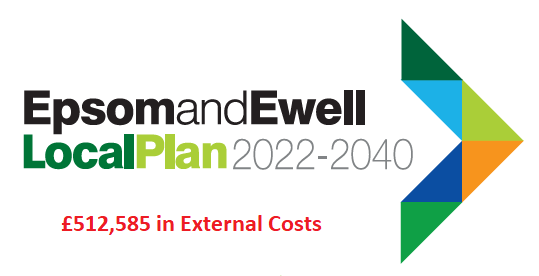
Information provided by E&EBC showing that for Local Plan external consultants fees alone, Epsom and Ewell Borough Council has so far spent £513k. This is excluding Planning Officers’ salary, which if included, the Council would have spent way over £1 million* already on the Local Plan. Sadly the Local Plan is still at early stage and future spending is likely to be high.
Unfortunately, some of the external reports are of poor quality with errors, some reports have conflicting information, and some reports are even suspected of Greenwashing in order to justify large and unusual development proposals of Green Belt lands.
According to Council’s document, Planning Officers’ salary are between £50k-£60k/year. Council has at least 5 officers, and assuming each officer spent 30% of their time on Local Plan, for the past 6 years, Council would have spent over £500k on Local Plan officers’ salaries.
The total spend on external services from 1st April 2016 until the 15 April 2023 was £513,214.83. This was split into two phases.
April 2016 – December 2021
Local Plan consultancy was £262,519.29 ( £3,861 per month )
Consultancy 2016-21 was £88,541 ( 33.7% ) Strategy 2016-21 was £45,626 ( 17.4% ) Studies 2016-21 was £119,788 (45.6% ) Publishing 2016-21 was £8,564 ( 3.3% )
There were 13 different external suppliers for Phase 1. The largest suppliers were Atkins Ltd ( £36,472 ) followed by Luther Pendragon ( £16,557 ).
January 2022 – April 2023
Support for Draft Local Plan was £250,695.54 ( £16,713 per month )
Consultancy 2012-23 was £127,736 (51.1% ) Strategy 2012-23 was zero Studies 2012-23 was £88,252 ( 35.3% ) Publishing 2012-23 was £34,044 ( 13.6% )
There were 11 different external suppliers for Phase 2. The largest suppliers were David Lock Associates ( £99,768 ) followed by GL Hearne ( £47,890 ). The spending on Publishing is excessive, which covered Graphic Design, Social Media, Printing
The budget and content of the Local Plan were approved by the Licensing and Planning Policy Committee. The Local Plan was approved for public consultation by the Licensing and Planning Policy Committee in Monday 30th Jan 2023. The meeting was attended by the councillors listed below. The decision was unanimous.
Councillor Steven McCormick (Chair) RA Councillor Peter O’Donovan (Vice Chair) RA Councillor Steve Bridger RA Councillor Neil Dallen RA Councillor Liz Frost RA Councillor Rob Geleit Lab Councillor Julie Morris Lib Dem Councillor Barry Nash RA Councillor Phil Neale RA Councillor Peter Webb RA Councillor Kate Chinn Lab
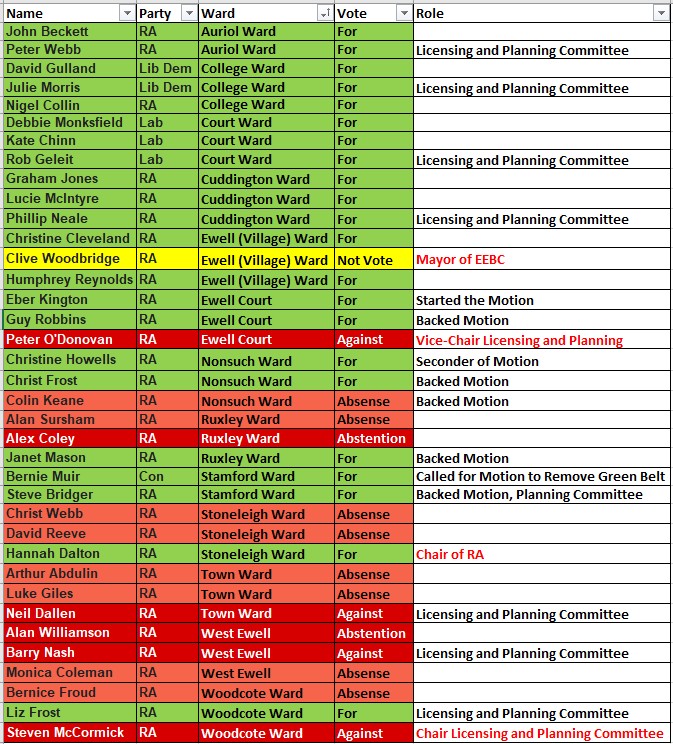
The table below shows how each councillor voted at the Extraordinary Council Meeting on 22nd March 2023. There were 8 absentees, only 4 votes against the motion for the meeting to pause the Local Plan. Members of the public may use the information when making the decision on how to cast their votes in the Council Elections that are expected to be on 4th May 2023.
#epsomandewell #localplan #greenbelt
Many thanks to What’s On in Surrey for the use of the image with the PAUSED message,
PRINCE CHARMING WAKES UP EPSOM COUNCIL OVER GREEN BELT
Not since Prince Charming woke Cinderella from a long slumber with a kiss, has there been such a momentous wake up call .
#epsomandewell #localplan #greenbelt
Last night, (March 22), at an Extraordinary Meeting of Epsom & Ewell Borough Council, the ruling group of Residents Association councillors were presented with a charming masterclass in resident democracy by Cllr Eber Kington (RA).
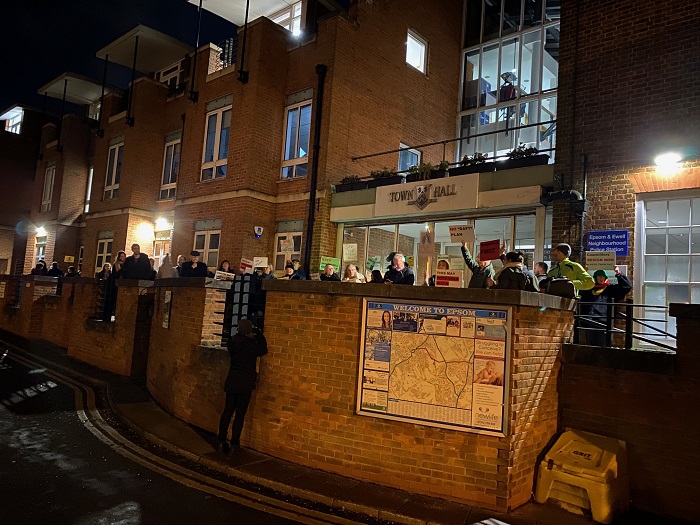
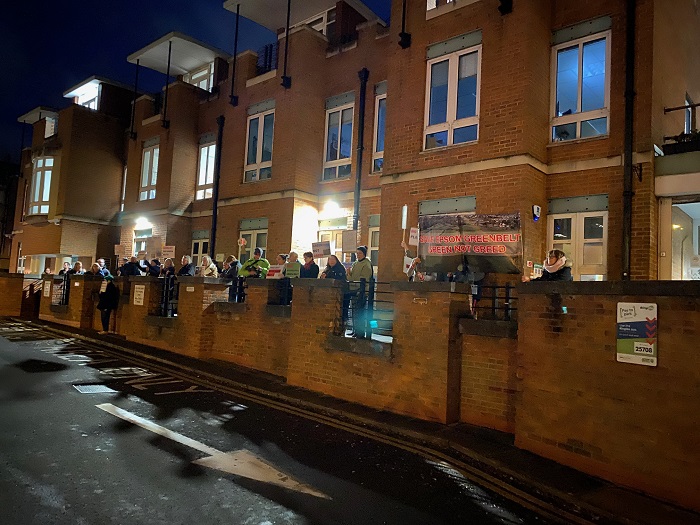
Outside, over 100 residents demonstrated against Green Belt destruction again, and a further 50 packed the Public Gallery to witness the councillors’ deliberations
As a result of Cllr Kington’s special motion, backed by six colleagues, the full council voted by 20-4 (with one abstention) to pause the Draft Local Plan, which proposed that over 40% of all new builds by 2040 , some 2,175 homes, should be built on five Green Belt sites in the Borough.
Such was the impact of resident alarm over a Plan put forward, unchallenged, by the Council’s Licensing and Planning Committee, that a record 10,000 petition was signed, over 1,500 individual written consultation representations were made, and large demonstrations were held in the town centre and Town Hall.
Cllr Kington reminded his colleagues that they had “to take notice of what our residents think, and a short pause will allow the planners to review further all brownfield housing opportunities, and take account of key government planning reforms, expected by end May. Using updated population data and not needing to review Green Belt for housing might mean a housing figure of 207 a year which can be accommodated by existing allocations on brownfield sites”
His remarks were backed up by motion seconder Cllr Christine Howells who said
“This Council cannot leave a legacy of destruction of our great Green Belt asset and should support the wider climate change and biodiversity agenda closer to home”
Other parties represented on the Council all backed a Plan pause, and noted that Local Elections in May would bring a sharp focus to the debate.
Councils around the country are now pausing their Plans, and local boroughs like Elmbridge, Kingston and Mole Valley are not intending to use Green Belt land.
The four voting against included the Licensing and Planning Committee chair Cllr Steven McCormick and vice-chair CllrPeter O’Donovan, who warned that there could be less development protection without a current Local Plan, and some Government planning reforms might not happen until 2024. One by one, however, the other RA councillors had their Cinderella moment, with Cllr Chris Frost concluding “We do need a Local Plan, but we need an acceptable plan, so let’s act like an RA council, and listen to the residents”
After the vote, Epsom and Ewell Green Belt Group campaigner Ms Yufan Si said “With the Local Plan likely to be obsolete in a couple of months, a pause makes sense, but we shall be asking the new Council in May to go further, and confirm its policy opposition to all Green Belt development in the borough, unless made mandatory by Government to meet imposed housing targets. We will ask all councillors standing to declare their policy commitment to Green Belt protection”
Tim Murphy, chair , Epsom’s branch , CPRE, said of the pause “Whatever the precise wording of the motion, I think it would be extremely difficult for a revised version of the Local Plan to be published in the future with any significant Green Belt loss”
The story may, or may not, end with everyone living happily thereafter.
I hereby summon you to attend a meeting of the Council of the Borough of Epsom and Ewell which will be held at the Council Chamber, Epsom Town Hall, Epsom on WEDNESDAY, 22ND MARCH, 2023 at 7.30 pm. The business to be transacted at the Meeting is set out on the Agenda overleaf.
Questions from the Public Questions from the public are not permitted at meetings of the Council.
Motion
This Council notes that:
Extensive green areas, especially the green belt, and the absence of high-level development in our urban areas makes Epsom and Ewell a distinctive, green and an excellent place to live.
Under the existing legislation Local Planning Authorities are being required to draft Local Plans on the basis of out of date, 2014, data that does not reflect Epsom and Ewell’s housing need, as shown in more recently available 2018 data.
The Government’s recently proposed legislative changes to the planning process, whilst welcome in several aspects, are not yet enacted and the current legal position has not changed.
These factors suggest that a pause in progressing the Draft Local Plan in its current form would provide an opportunity to assess the Government’s draft proposals as well as the 2018 data on housing need in the borough.
This Council therefore agrees that: i. Other than for the purpose of analysing the responses of the public consultation to capture residents’ views and any new information, the Local Plan process be paused to enable:
a) further work on brown field sites, including information arising out of the Regulation 18 consultation b) further options to be considered that do not include green belt sites c) an analysis of Epsom and Ewell’s required future housing numbers based on 2018 data d) a clearer understanding of the Government’s legislative intentions in regard to protections for the green belt and the current mandatory target for housing numbers.
ii. Write to the MP for Epsom and Ewell calling on in him to use his influence to get the Government to abandon its use of 2014 data to calculate housing need and accept that all planning and housing policies must reflect the latest data if they are to be effective as well command the respect of the people they affect.
Relevant Committee and Chair of the Committee
Licensing and Planning Policy Committee Chair: Councillor Steven McCormick
Due to the unprecedented levels of objections from E&EBC residents, a special Council Meeting to review the Local Plan has been called.
CALL FOR ACTION:
1) Special Council meeting will be held on Wednesday 22nd March @7:30pm at Epsom Town Hall, The Parade, Epsom, KT18 5BY 2) Please email democraticservices@epsom-ewell.gov.uk to attend in person and ask a question 3) Please also arrive early at 6:50pm in front of Town Hall (Car Park side) for a Public Demonstration(bring your own placards).





 Keep Epsom & Ewell Green Belt